‘Foot Soldiers Of Democracy’: Belmont’s State Senate Recount Reaffirms Brownsberger’s Victory

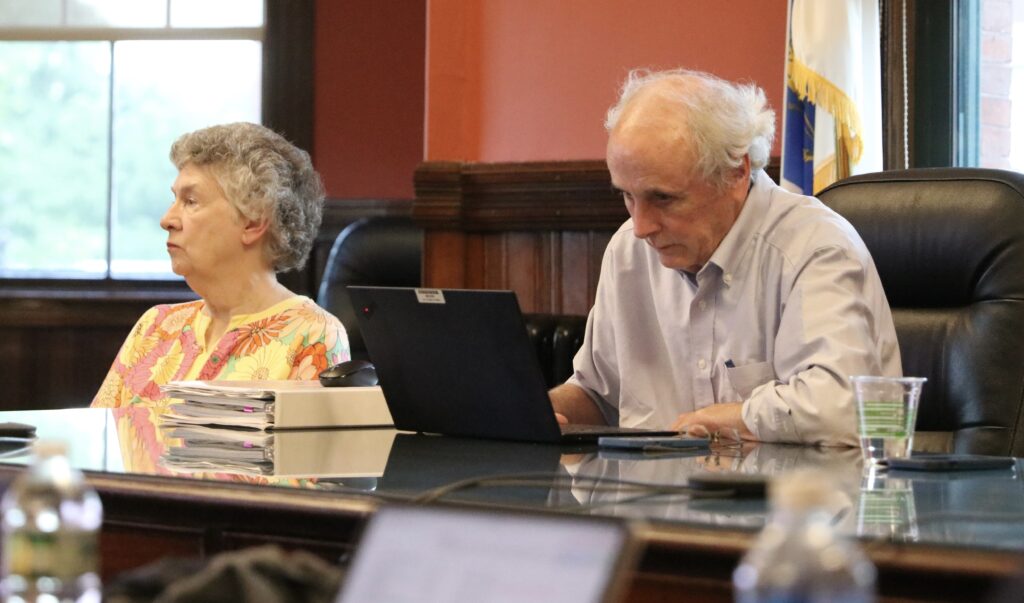
Photo: The state senate recount at Belmont Town Hall auditorium

Call it a day of direct democracy.

On Sept. 10, Belmont witnessed democracy in action in the Town Hall auditorium. For more than four hours, a roomful of volunteers, observers, town officials, and a candidate participated in the re-enumeration of the Democratic Party primary election for state senator held on Sept. 1.

In the first go-around of voting the previous week, incumbent and Belmont resident Will Brownsberger eked out a 34-vote advantage district-wide over first-time candidate Daniel Lander of Boston: 12,291 to 12,257. As the closeness of the outcome was within the right to ask for a recount, both candidates submitted signatures from the four communities – Belmont and Watertown and precincts in Boston and Cambridge – represented in the Suffolk and Middlesex District. On Election Night, Brownsberger easily won his hometown, 4,010 to 1,809, although he lost the other three communities he had been representing since 2011.

Registrars of Voters Chair Bob McGaw

Pairs of community volunteers sat at 20 card tables to re-tally each of the 5,824 ballots submitted at the town’s eight voting precincts and those that were submitted early and through the mail. Managed by Town Clerk Ellen Cushman and her staff and overseen by the Belmont’s Registrars of Voters, each candidate was allowed two “campaign agents” to oversee the recount, and note any challenges to the decision by the reader. And in the hallway outside the hall, Brownsberger waited for the results to be called. 

Each table received a stack of 50 votes, which were counted to be approved by the Registrars, chaired by Bob McGaw in his final year in the post. Kristen Gagalis, an associate with Anderson & Kreiger, kept the proceedings moving by resolving any procedural questions and reminding those assembled to keep the chitchat to a minimum. 

With a steady rhythm, carts of ballots were brought from the Town Clerk’s storage room – once the town’s lockup – and numbers were calculated and approved. And with each enumerated result, the vote advantage Brownsberger held in Belmont never varied by more than a single vote up or down. By 1:30 p.m., all the ballots were read and reaffirmed; Brownsberger would add two votes to his tally, and Landers three extra votes. The final numbers: 4,012 to 1,812, a 2,200-vote margin. 

By the end of the recount, the attorneys for both campaigns had high praise for the process and how it was conducted. 

“This really is what democracy is all about. You guys are the foot soldiers of democracy. You worked hard, and we really appreciate it, and I think everyone should,” said Brownsberger’s Dennis Newman, whose history with recounts included being the lead Democratic attorney observing the critical Palm Beach, Florida, review of votes in the historic Bush/Gore presidential recount of 2000.

“Today was part of our democracy,” said Lander’s attorney, John Gannon. “We fought 250 years ago to have that right to vote, the right to be heard in a democratic process. So this is part and parcel of that process, and I’m truly honored to be part of the process.”

On Friday, the Secretary of the Commonwealth certified the election, and Brownsberger is returning to Beacon Hill with a 35-vote advantage: Brownsberger 12,291, Lander 12,257.

The contest between the long-serving legislator and a neophyte candidate had its origins in a successful effort by Brownsberger and other legislators to deny an effort in 2024 by Boston Mayor Michelle Wu to temporarily raise the commercial real estate tax rate to ease the tax burden on residential taxes. Many saw the rare primary challenges to the long-standing legislators as Wu’s atttempt – with campaign donations and use of political connections – to send a message of her disapproval.

It was Brownsberger who had the final word.

“I wanted to share the good news right away: the recount is complete, and we have prevailed with a final margin of 35 votes,” said Brownsberger in a statement released on Thursday afternoon after the completion of the recount in Cambridge. Watertown and Boston completed their review on Wednesday.

“I am so very grateful for all your work and support in this campaign. I look forward to continuing to serve all of the people in my district, and I am eager to get back to work.”

In his statement, Lander said while the race “did not end as we’d hoped, I am so deeply proud of the campaign we built. I know we have woken up the State Senate and sent a message loud and clear that the days of delay and inaction must end now. Despite the establishment’s best efforts, this campaign won three of the four communities of this district. After being outspent two to one, our grassroots coalition made clear this district is hungry for change.”

Registrars of Voters: Ellen O’Brien Cushman, Ex-Officio, Paul Minor, Kate Foster, and Bob McGaw

Update: Too Close To Call As Brownsberger Carves Out 61 Vote Advantage Over Lander In State Senate Race

Photo: Will Brownsberger

On a night that saw one of the candidates announce he would probably loss than reverse that prediction an hour later and the other declaring victory no matter the decision, just who will be the next state senator representing Belmont remains up in the air.

With 100 percent of precincts reporting, 15-year incumbent Will Brownsberger has a minuscule 61-vote advantage – 11,997 to 11,936 – over his opponent first-time candidate Daniel Lander, a former policy advisor for Boston Mayor Michelle Wu.

Neither Associated Press or the Boston Globe have called the Democratic primary race for the Suffolk & Middlesex Senate seat as of 5 a.m., Wednesday, Sept. 2.

If Brownsberger does retain his seat he first won in Nov. 2011, it will be due in large part to the strong showing of support from his hometown voters. Belmont was the only segment of the districted he won, as the long-time legislator come up second in Boston, Cambridge and Watertown to the first-time candidate.

Brownsberger took the Town of Homes 3,974 to 1,793, a 2,181 margin that allowed the two decade incumbent to create enough of a cushion to stay in the lead for the majority of the night.

But even after Belmont and Watertown reported, Brownsberger surprisingly told campaign supporters who gathered at Donahue’s Bar and Grill in Watertown that it was not going to be his night.

“[The results are] not looking that good tonight,” Brownsberger told supporter before 10 p.m. “We might have lost,” Brownsberger said, reported the Boston Globe. “I’m not quite saying that yet, but as is my way upfront, that’s what I’m seeing out there.”

A Brownsberger backer from Belmont who attended the victory celebration, said the candidate’s “forthright” announcement took a large segment of the smallish crowd by surprise. “It is sooo early and the [reported] numbers said he is in the lead,” the supporter’s text. “[Brownsberger] must know it’s already over.”

But at the 11th hour, Brownsberger told the crowd his earlier prediction did not include complete Belmont returns – Belmont Town Clerk Ellen Cushman announced the returns at 9:16 p.m. – and the vote count was now “in his favor.”

Lander entered the race with the endorsement and backing of his former boss Wu, who has been in a nasty political spat with Belmont’s veteran legislator over 2024 legislation in which he helped block a tax bill to temporarily shifted more of Boston’s property tax burden on to commercial owners.

Brownsberger would hold a 1,500 vote lead at 11 p.m. only to see the advantage slip away with each Boston precinct being called.

With Brownsberger holding on to a tight 325-vote lead after Boston’s 35 precincts were called, Cambridge votes were the final ones tallied sometime after 2 a.m. And while Landers carried his one-time hometown, he couldn’t close the gap.

It is uncertain if a recount is required or if Lander will ask for one.

In the other legislative race for the 24th Middlesex (The ABC District has it covers Arlington, Belmont, and Cambridge,} state Rep. Dave Rogers used his tireless retail campaign style to return to Beacon Hill as he defeated another first-time candidate Nomita Ganguly, 6,906 to 2,867. Rogers received 3,462 votes to Ganguly’s 2,043.

Middlesex District Attorney and Belmont’s own Marian Ryan will continue to uphold the law as she defeated David Marc Solet easily.

Early results: Brownsberger Says ‘[Election] Not Looking That Good Tonight’ As Hometown Comes Out Big For Long-Time Senator

Photo: Will Brownsberger

With nearly 40 percent of precincts tallied, State Sen. Will Brownsberger could see the writing on the wall.

“[The results are] not looking that good tonight,” Brownsberger told supporters gathered at Donahue’s in Watertown just before 10 p.m. on state primary night, Sept. 1.

“We might have lost,” Brownsberger said, reported the Boston Globe. “I’m not quite saying that yet, but as is my way upfront, that’s what I’m seeing out there.”

Brownsberger’s reaction came just a half-an-hour after Belmont voters showed its support for the long-standing legislator. Town Clerk Ellen Cushman reported Brownsberger received 3,974 votes to his opponant Daniel Lander who garnered 1,793, a more than a two-to-one margin.

But Brownsberger isn’t rounding up that same level of support in the rest of the district, being edged out in his birthplace of Watertown and running behind in early returns in his Boston precincts where Lander had the advantage of the endorsement of Boston Mayor Michelle Wu.

Final results are expected soon.

Letter To The Editor: Brownsberger, ‘A True Public Servant’

Photo: Will Brownsberger

To me, Will Brownsberger is the definition of a public servant.

I first met Will in 2017 over a bill I was deeply concerned about. Of all the elected officials I spoke with, he was the only one who truly understood the issue despite the prevailing narratives. 

As an immigrant new to this country, I was self-conscious—not just about my English, but about everything. Will was incredibly encouraging and became a mentor to me. Since then, we’ve worked together on several projects, most recently on dental care coverage for head and neck cancer survivors.

Will is compassionate, thoughtful, and a man of his word. When he says he will do something, he does it. In an era when many people are frustrated by politicians who make big promises but deliver little, Will stands out because you can trust that he means what he says.

I’ve never seen another elected official publish a personal cell phone number in a full-page local newspaper ad, inviting constituents to reach out directly. Even more remarkably, he replies to every email and text—and quickly. I often wonder how he manages to do it.

After the COVID-19 pandemic, the local Asian community hosted a cultural celebration. Will was the very first guest to arrive, well before anyone else. It genuinely surprised the organizers and made all of us feel seen and honored.

Will is transparent. He regularly updates constituents through his blog and writes thoughtful analyses on various policy issues. I remember one reader challenged him to read a book presenting an opposing viewpoint. Will accepted the challenge and wrote back with his thoughts. That openness has earned him respect, even from many people who disagree with him.

Will has earned my vote again in Sept. 1.

Ye Zhang Pogue 

Lewis Road

Brownsberger To Be Challenged For Senate Seat By Boston Resident With Belmont Tiess

Photo: Will Brownsberger

For the first time since winning a special election in 2011, State Sen. Will Brownsberger will have a significant Democratic challenger for his 2nd Suffolk & Middlesex Senate District seat in the upcoming state party primary election in September 2026.

Daniel Lander, a senior policy advisor to Boston Mayor Michele Wu and the chair of Boston’s Ward 21 Democratic Committee that represents Allston, Brighton, and Fenway, has pulled papers to run for the seat Brownsberger has held for the past 15 years.

“The communities of this district are under attack from the Trump Administration. We need a State Senate that stands up for our knowledge economy, brings down costs, and isn’t stuck defending a broken status quo,” said Lander in an opening announcement of his campaign. “I look forward to hearing the concerns and dreams of residents and sharing my vision for an affordable, livable Massachusetts over the months to come.”

The Suffolk and Middlesex District includes most of the Fenway neighborhood and the Allston and Brighton neighborhoods of Boston, Watertown, Belmont, and West Cambridge.

First published in POLITICO’s Massachusetts Playbook newsletter on Dec. 10, Lander campaign is closely linked to a political squabble between Wu and Brownsberger over the mayor’s attempt to shift a more significant amount of property taxes onto businesses, in an attempt to reduce an expected 13 percent tax increase on residential homeowners in fiscal 2026. Brownsberger is one of the legislators working to stave off a vote on Wu’s initiative, which requires legislative approval. Local reporting points to Wu’s support of several candidates to stand against those legislators.

A graduate of Harvard College and the Kennedy School of Government, Lander has led a land audit of Boston that identified locations where hundreds of new affordable homes can be built while reducing red tape by authoring and implementing an executive order to accelerate the permitting process by 50 percent.

A native of Huron Village in West Cambridge, Lander has a strong connection to Belmont, being a member of Temple Beth El Center on Concord Avenue since he was a child. Lander’s father is Eric Lander, geneticist, mathematician, and molecular biologist known for his leadership of the Human Genome Project and as the founding director of the Broad Institute of MIT and Harvard. 

Usually the bi-annual state party primaries for both of Belmont’s Beacon Hill representatives are pro forma affairs, as the two long-time seat holders have been challenged once in the past decade when Jennifer Fries ran against State Rep. Dave Roger in 2020.

After the last Massachusetts legislative redistricting in 2021 that took effect in 2023, Belmont currently represents 25 percent of the population in the 2nd district, behind Boston (43 percent) and Watertown (32 percent), making for an interesting race if it remains a two-candidate contest. With the incumbent and challenger having natural constituencies, it would likely be that the race could be decided by Watertown voters, although Brownsberger resided in Watertown before moving to the “Town of Homes” in the early 1990s.

One observer noted the primary’s date of Sept. 1 will likely limit the participation of Boston voters in the student-heavy district as it coincides with the first days of classes and moving into dorms and apartments.

State ‘Very Likely’ To Provide $750K Rink Earmark As Special Town Meeting To Determine Project’s Fate

Photo: The Municipal Skating Rink Building Committee at the public forum held Wednesday, May 22. Town Moderator Mike Widmer (center) led the event

With a critical Town Meeting vote on the future of the proposed Municipal Skating Rink two weeks away, some much-needed good news for the beleaguered rink project came in the form of a $750,000 state budget appropriation shepherded to the town by State Sen. Will Brownsberger.

The announcement of the last-minute state budget earmark came the same day as a community forum held by the Municipal Skating Rink Building Committee on Wednesday, May 22, at Town Hall. It was also just two days after the Belmont Select Board approved a Special Town Meeting to vote to close a $2.1 million expense overage in the project’s original $29.9 million price tag.

“We got some good news related to the state budget,” Rink Building Committee member Tom Caputo told the two dozen residents at the meeting. While a final state budget won’t be approved by July, “if the town approves the natural refrigerants for the rink [at the Special Town Meeting], the town can count on receiving $750,000 from the state to cover the expenditure.”

The new rink will be equipped with a $650,000 CO2 refrigerant system. Popular in Canada, the carbon dioxide technology, while nearly twice as expensive as the standard Freon gas-based system, is considered environmentally superior. Due to its impact on global warming, Freon is expected to face strict limits or outright bans in the next decade.

If funds are left over after the CO2 system is paid for, it’s possible the rest can be carried to “cover other environmental compliance costs,” said Caputo, adding that Brownsberger will come before the Special Town Meeting “to share this in person.”

It is still unclear what percentage of the state funding can be used to reduce the rink’s shortfall. After Wednesday’s meeting, Town Administrator Patrice Garvin said her office and the Select Board – which has the ultimate authority on how much town funds will be requested in the article – are creating a plan that will allocate the greatest amount to the project.

When answering a question on Wednesday by Town Meeting member Jack Weis (Precinct 1) if receiving the state funding will reduce the deficit from $2.1 to $1.4 million, Caputo said, “[i]t’s safe to say a significant portion of it will be used to reduce the ‘ask’ of town’s funds.”

Wednesday’s funding announcement is the first bit of positive news for the building committee, which has been scrabbling for the past three months to drain the $5.1 million in red ink.

Cost drivers skyrocketed

At the Monday, May 20 Select Board meeting, Building Committee Chair Mark Haley and members Caputo and Dante Muzzioli reiterated how the building project is facing a shortfall. According to Haley, the rink project was affected by unprecedented increases in material and labor costs, unforeseen toxic waste discoveries, site complications, and schedule delays.

The most significant impact of the escalating expenses in the past year resulted from a cost explosion in materials, labor, and services between September 2023 and February 2024, which saw the cost skyrocket to $35.1 million. According to Haley, the rink’s top four cost drivers include:

  • $740,000 in General Requirements, including general contractor Skanska’s labor,
  • $700,000 for site work,
  • $550,000 in additional costs for concrete and
  • $450,000 for masonry work.

When you add a few more line items that saw double-digit increases, the project experienced a rise of $3.4 million to the bottom line “in just trade costs and labor,” Haley said.

Faced with a need to cut costs quickly, the building committee began a value engineering process. But unlike most construction projects, an athletic facility doesn’t have much excess to cut: Haley said the building is “basically a box” with a few rooms and mechanical areas.

Municipal Skating Rink Building Committee members Anne Marie Mahoney and Chair Mark Haley.

After the revision, the committee approved two significant changes: the main lobby will be removed, reducing the structure by about 2,500 sq. ft., and the proposed solar array that would supply power to the facility will not be installed, saving $1.2 million.

On the plus side, Option A will have all the programming supporters promised in the original design: four locker rooms to replace those lost in the razing of the White Field House, recreational storage, bathrooms that can be used when the rink is not in use, a skate rental/sharpening shop, a concession stand, and four dressing rooms.

Having value-engineered a total of $3.3 million in savings, the building committee discussed with town officials helping to foot the remaining shortfall. Garvin advised the Select Board an inactive town account named after the insurance settlement from a fire at the former Kendall School is available as a source. The $2.1 million account was created to meet future capital needs, which is seen as an appropriate use for the rink.

If the Special Town Meeting rejects the June 10 article, Haley said it’s now clear to observers that a barebones facility will not attract the support of the committee or the community to move forward.

“There is no Option B. It’s either the rink we promised or nothing,” said Haley after Wednesday’s meeting.

Brownsberger Seeking Applicants For Summer Internships

Photo: State Sen. Will Brownsberger is accepting summer internship applications (The Massachusetts State House on Beacon Hill, Boston (Credit: Upstateherd – Own work, CC BY-SA 4.0, https://commons.wikimedia.org/w/index.php?curid=62661950)

The Office of State Sen. Will Brownsberger is accepting applications for part-time, unpaid general office and legislative internships for the summer of 2024. Applications are due Monday, April 8.

Read our website post for details about the internships and how to apply. 

Questions? Contact Eric Helmuth – eric.helmuth@masenate.gov – Brownsberger’s chief of staff.

Brownsberger Accepting Summer Internship Applications

Photo: State Sen. Will Brownsberger is accepting summer internship applications (The Massachusetts State House on Beacon Hill, Boston (Credit: Upstateherd – Own work, CC BY-SA 4.0, https://commons.wikimedia.org/w/index.php?curid=62661950)

State Senator Will Brownsberger is accepting applications for part-time, unpaid internships for the summer of 2023. Applications are due on Monday, April 10.

Two types of opportunities are available: general office internships for high school and college students and legislative internships for college grads and law school students.

Read the senator’s website post for details about the internships and how to apply.

Any questions? Contact Kimberley Hutter, kimberley.hutter@masenate.gov

Summer Internship On Beacon Hill With State Rep. Rogers

Photo: The Massachusetts State House on Beacon Hill, Boston (Credit: Upstateherd – Own work, CC BY-SA 4.0, https://commons.wikimedia.org/w/index.php?curid=62661950)

High school and college students with a keen interest in government has an opportunity to participate in a summer internship with Belmont’s legislative delegate in the State House on Beacon Hill.

State Rep. Dave Rogers will be welcoming interns to his team at the State House for the summer. The internships are available to college students, graduates, and high school students who have completed their junior year from the 24th Middlesex District.

Feedback through the past few years is that interns enjoy a richly rewarding experience and learn a great deal about our system of government generally, and the legislative process specifically. Particularly in times like these, it is rewarding to help young people begin to understand the importance of our democratic institutions.

The deadline for applications will be Friday, April 8 (with some flexibility). Interviews will take place over the ensuing weeks, and applicants will be notified of their status by early May at the latest. Those interested in applying should send both a cover letter and resume to Kira Arnott at Kira.Arnott@mahouse.gov

Opinion: My Support For Bill To Allow Drivers’ Licenses To Residents Without Lawful Immigrant Status

Photo: Sample of a Massachusetts commercial drivers’ license. (Credit: mass.gov/rmv)

By Will Brownsberger

Current Massachusetts law provides that “no [driver’s] license of any type may be issued to any person who does not have lawful presence in the United States.“

A bill currently before the senate would change that sentence to read: “An applicant for a [driver’s] license … who does not provide proof of lawful presence, … , shall be eligible … if the applicant meets all other qualifications for licensure and provides satisfactory proof to the registrar of their identity, date of birth and Massachusetts residency.”

In other words, the bill would give licenses to people who cannot prove lawful presence in the United States, provided they can prove their residence and identity and pass the same tests that everyone else has to pass.

I plan to support the bill.

My fundamental view about immigration policy is that it is up to the federal government. It is not the concern of state and local government. However, one of the top concerns of state and local government is to assure that all drivers know the rules of the road and how to operate a vehicle safely. It is often necessary to drive and we are all safer if more of the people on our roads have the required training and insurance.

Some argue that to discourage illegal immigration, we should make life in Massachusetts as inconvenient and uncomfortable as possible for people without lawful immigrant status. I do not agree with that approach. We hurt ourselves when we isolate people in our midst. We benefit from immigrant labor in many occupations and we should treat all workers as well as we can.

Others express the valid concern that a driver’s license is an identification card and we do not want to facilitate the creation of false credentials. The bill gives this concern careful attention in two different ways. 

First, the bill does not allow persons who cannot prove lawful presence to get a “Real-ID” which would get them into federal buildings and on to planes. Instead, they will get a card that is valid as a license to drive but is not valid for federal identification.

Second, applicants for a license who do not possess United States identity credentials like a U.S. passport will have to provide similarly rigorous foreign credentials — a foreign passport or an identity card issued by their consulate. In addition, they will have to provide a corroborating document like a license from another state or a birth certificate. At least one of the proferred documents must be a photo ID and at least one must include birth date.

Some have expressed the concern that since one can register to vote through the drivers license application process, the new law would allow non-citizens to vote. Again, the law specifically speaks to this, requiring the Registry of Motor Vehicles to “establish procedures … to ensure that an applicant for a Massachusetts license … who does not provide proof of lawful presence shall not be automatically registered to vote.” The law would not take effect for a year, allowing time to assure that these procedures are in place.

While the new law cements the requirement of procedures to protect the voter rolls, procedures are already in place according to the Secretary of State. He states on his website that “The RMV … collect[s] information about lawful presence in the United States and they will not submit names to local election officials of any persons they have determined are not U.S. citizens.” This is not a new concern. Currently many people who are not citizens but are lawfully present in the United States have drivers licenses: for example, a green card holder can get a license.

Similar legislation has been passed in 16 other states. The bill has the support of many law enforcement officers, including the Sheriffs of Middlesex County and Suffolk County, and the police chiefs of Cambridge, Belmont, and Watertown. 

The Massachusetts House of Representatives has already voted for this bill by 120-36. I expect the Senate to take it up and I hope we are able to give it a similar strong endorsement and send it to the Governor’s desk.

Belmont resident Will Brownsberger is a Massachusetts state senator representing the Second Suffolk and Middlesex District that includes Belmont.