Early Morning Blaze Consumes Muzzy’s, Owner Sees Possible Return ‘Of My Happy Spot’

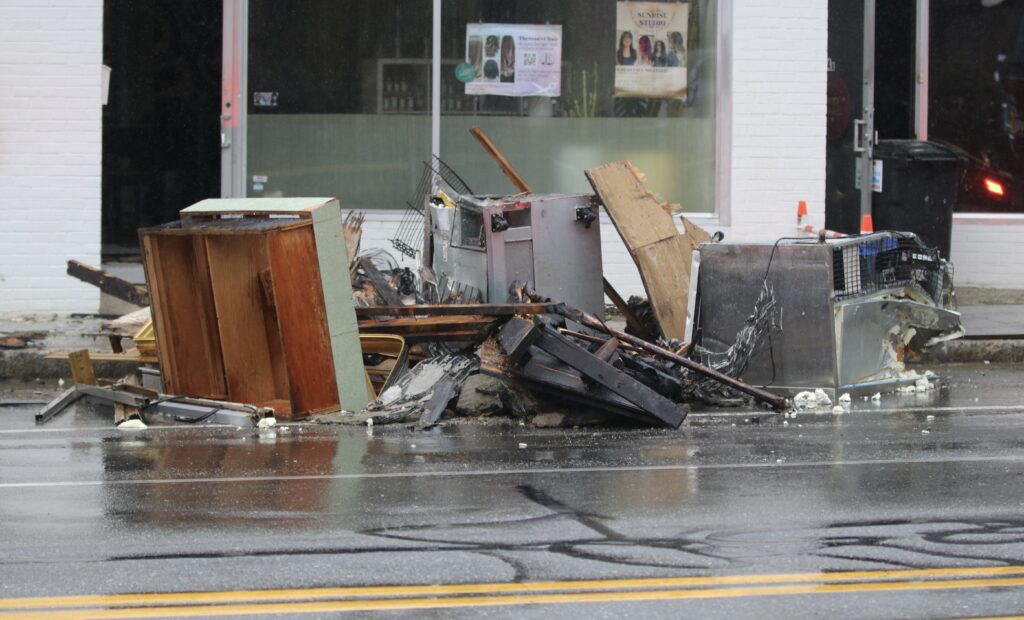
Photo: Muzzy’s owner Dante Muzzioli greets a friend at the scene of the fire that destroyed his business on Thursday.

An early morning three-alarm fire on Thursday, May 14, destroyed Muzzy’s, a favorite of Belmont residents with its diner-inspired menu and outdoor seating, which made it a popular summer eating destination.

“It’s a complete loss,” said Dante Muzzioli, the Belmont business owner and high school hockey Hall of Fame coach who named the eatery using his popular nomignolo

“Well, it’s a sad day,” he said.

From the rain-soaked sidewalk across Trapelo, passersby and Muzzioli’s friends watched as fire crews continued working. While the structure’s white exterior walls were still intact, the interior was a blackened cavity from the fire that spread quickly from the basement to the first floor. 

“The whole floor is gone. Everything’s in the basement,” said Muzzioli as he inspected the damage with Belmont Fire personnel and spoke to contractors to board up the windows. 

For Muzzioli, the location was more than a business opportunity. Muzzy’s was his way of bringing a little bit of joy to people’s lives and his own.

“I look at it as my happy spot. And that’s really what it’s about. We’re living in a world that’s upside down. Some days, we’re all fighting politically about who believes in this and who believes in that. But when you come here and you see little kids eating ice cream, how can you not be happy.”

As the Belmont Fire Department was making a final inspection of the structure, Muzzioli greeted friends, hockey acquaintances, and people who casually knew ‘Muzzy’ to offer their condolences with handshakes and hugs.

“It’s been overwhelming,” said Muzzioli of the support he’s received in the few hours after the fire began. “It’s been incredible how many people have come here just to say how sad this all is or what they can do to help. I’ve received a text from [Belmont Select Board Chair] Matt Taylor, and [Select Board member] Carol [Berberian] showed up at 6:30 a.m. just because they cared.”

Muzzioli said he learned about the fire from one of his employees who was driving by the business and saw some smoke inside. After getting a closer look, he called 911 and his boss. But in mere minutes for the Belmont Fire Department to arrive, “the thing was pretty much engulfed.”

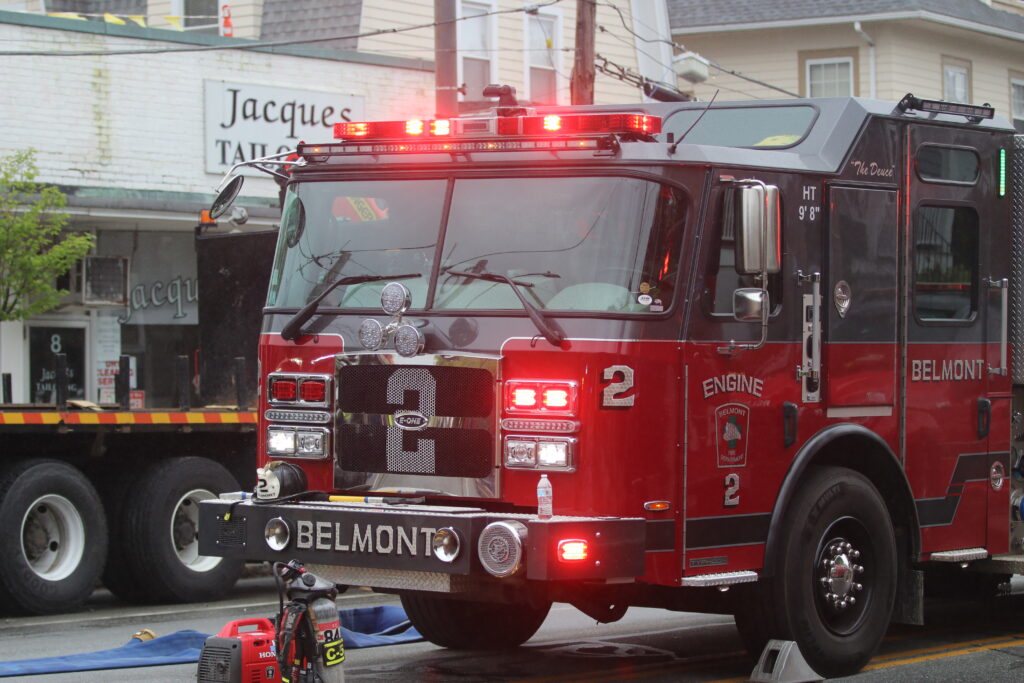
The Belmont Fire Department arrived on the scene at approximately 4:30 a.m., having received a report of heavy smoke coming from the building, said Belmont Fire Chief David DeStefano, who was at the scene during the afternoon cleanup.

“We made an aggressive interior attack and determined the fire to be located in the basement,” said DeStefano. While companies were trying to enter the basement, the main floor became unstable and in danger of collapse. 

“That’s when we withdrew our firefighters from the building” said DeStefano, at which time Belmont firefighters, along with mutual aid from Waltham, Cambridge, Arlington, and Watertown, went to defensive operations for the duration of the firefight.

As the primary conflagration was being brought under control, a gas-fed fire started due to a broken gas line, said DeStefano. “We contained that fire, and did not let it spread until National Grid was able to turn off the gas. At that point, we brought the remaining fire under control.”

But due to many hidden pockets of fire and hot spots, the fire remained only contained into the afternoon. The arrival of an excavator “allowed us to pull things apart, remove material from the building, and finally get to the deep-seated fire to bring about final extinguishment.”

A cause of the fire has not been determined, as fire inspectors have just begun their work, said DeStefano.

The four retail businesses in the one-story building that housed Muzzy’s had varied amounts of smoke and water damage, with Lucy Danger Hair suffering the bulk of the resulting loss.

Opened in 2012 at the intersection of Belmont Street and Trapelo Avenue, where a Brigham’s Ice Cream shop operated for many years. 

“I came here when I was a little kid, 12 years old, when this was a Brigham, riding bikes with his friends from Winn Brook to get a raspberry lime ricky.” 

Muzzioli – a lifelong Belmontian who owns a landscaping and construction company and coached Belmont High School Boys’ Hockey for four decades – became interested in the location as he saw the business deteriorate over the years. “It wasn’t the same place as I remembered it,” said Muzzioli.

As a lifelong entrepreneur, Muzzioli asked if putting a new ice cream store at the location was a viable situation, mimicking the Brigham’s ideas but putting some of his new concepts in place, including installing a grill that would support a diner-style menu. In the past decade and a half, the restaurant/ice cream business took off.

“It’s been great. The Fridays and Saturdays in the summer: packed, packed, packed. It’s a nice area to sit outside and eat ice cream, with a little piece of grass out here to manage kids and stuff like that,” he said.

Muzzy isn’t ready to accept defeat. 

I’m going to try to put a remote ice cream store here,” Muzzioli said, pointing to the green space untouched by the blaze. “So I’m going to work my tail off next few days and see if I can operate a little stand in here in the greenery.”

Town Meeting Passes Belmont Center Overlay, Hotel Bylaw; Rejects Move To Postpone Controversial Measure

Photo: Select Board Chair Matt Taylor (left) and Select Board member Elizabeth Dionne offer congratulations as the measure creating the Belmont Center Overlay District passes at the March 4 Special Town Meeting

After an hours-long debate, a Special Town Meeting on March 4 approved creating a Belmont Center Overlay District, which town officials and supporters believe will spur needed development and revenue growth and housing opportunities in the town’s business hub.

The vote margin on Article 2 – 172 in favor, 82 opposed, with 7 abstentions—was surprising to many who attended the meeting in the Chenery Upper Elementary School auditorium and online believed a late social media push by those opposing the measure would result in a long night with an uncertain outcome that Kalshi would have given even odds.

But a healthy majority of Town Meeting Members rejected the attempt by critics to indefinitely postpone the vote and see the article return in the fall, after undergoing an extensive revamping to further modify down the height of structures and identify “realistic” parking solutions allowing Belmont to continue to uphold its “our small-town feel.”

But the maneuver was dismissed by backers, with one overlay supporter saying it “[was] just a warm and fuzzy way to kill [the plan].”

“All of us, regardless of which side we’re on, should want to get back to [our constituents] with a yes or no answer,” urged Julie Crockett (Precinct 5), saying that “[Town Meeting] wouldn’t be voting on this proposal that we’re all intimately familiar with. It would be something else.”

And just before 10:30 p.m., Town Meeting stood behind the town’s and the Planning Board’s construct.

“I’m shocked [at the size of the yes vote],” said Chris Ryan, Belmont’s town planner and chief architect of the form-based plan, who counted himself as one who felt the decision would be a nail-biter. “I’m pleased and proud of the citizens for their vote of confidence,” said Ryan as he accepted praise from supporters on Wednesday.

A day later, on Thursday, March 5, the Special Town Meeting voted approval of Article 3, which places an overlay on three parcels along Concord Avenue that could open a way for a lodging house to come to Belmont, which hasn’t been home to one since the Wellington Olmsted Tavern, which was demolished in 1897.

The lopsided margin of the 261 members voting yes over the two nights is being touted as a historic vindication of those who developed and campaigned for the Overlay District, revealing that residents are eager to take bold steps to revitalize other areas of town.

“I think we are now living in a different dynamic,” said Taylor Yates, the Select Board’s vice chair, who spearheaded the board’s efforts supporting the measure. “Belmont is saying ‘yes’ to things.
I think we’re trying to be more positive and proactive as we watch the surrounding communities change.”

Thayer Donham, chair of the Planning Board, said the members decision proved the body has faith in the board’s deliberative process, which will benefit future projects.

Dionne echoed Yates and the Planning Board on the importance of passing both bylaw measures.

“This is an inflection point,” Select Board member Elizabeth Dionne said of the articles’ sweeping passage. “This is pivotal. And I don’t want to say that it’s only symbolic. It’s a relatively simple plan because it’s small and contained. If we couldn’t get this across the finish line, we couldn’t get anything across the finish line.”

“Every time we try to create one of these plans, it requires a huge investment of time, staff, and money for consultants; we can’t justify investing that again if we were unable to finish this. So this lays the groundwork for everything else that the town wants to do,” said Dionne.

‘Yeah, we get it’

In the view of supporters, not many voters were swayed by the two nights of debate, as campaigners had made a successful pro-Overlay pitch to undecided members months previous. 

“There was one constant since January 2025. The more we talked to residents about the plan, the more they said, “Yeah, we get it,” said Yates. 

Dionne – who held informational meetings at her house for members from each precinct to explain the plan in late 2025 – was also not surprised by Town Meeting’s sweeping endorsement of the new bylaws.

“I thought we’d get there because my experience was that once people came into my house and I explained the plan, it wasn’t this big, scary plan. A lot of people came in skeptical but left saying, ‘I like that. That could actually be really nice.'”

The Belmont Center Overlay is designed to address three main concerns of the town, said Donham, who presented Article 2 to the assembly: maintain Belmont Center as a vibrant downtown, meet the needs of downsizing seniors and others who want smaller housing options, and begin addressing the financial challenges of a town with a minimal commercial tax base. 

“[T]onight, we’re presenting a real opportunity to begin generating more revenue. More effective zoning will attract private investment into our community while the town maintains control of the finished product,” said Donham.

The overlay district allows structure heights within the four zones varying from two-and-a-half stories in Zone 1 to five stories in Zone 4. At least two stories of commercial space are required in all zones, with limited residential development required, helping establish a built-in customer base for Belmont Center businesses.

While presenting details of the district, Ryan noted the center’s existing zoning code is limiting, allowing by right only two-story structures and 28 feet in height, “and that’s why nothing happens here.” 

The new form-based zoning code will give Belmont “more control over the appearance of the buildings and the streets. It’s a proven planning tool that’s been used around the country and in communities across Massachusetts” including Brookline, Watertown, and Littleton.

Ryan told members the Planning Department and Planning Board held 30 public meetings and listening sessions in the past 14 months, incorporating public input and altering major aspects of the plan, including reducing maximum heights and excluding the Claflin Street Parking Lot from development. Traffic and parking studies and a financial analysis were conducted.

When debate commenced – with nearly 30 members waiting before two microphones – those opposing the zoning change were the first to speak, and they sent out one of their heavy hitters, former Town Moderator Mike Widmer (Precinct 5).

“I’ve never seen an issue with this scope come before Town Meeting with so many questions,” Widmer told the 140 members who attended in person, adding that “[n]o comparable town in Massachusetts has undertaken anything of this magnitude in such a concentrated geographic area.” 

Widmer said the main concern focused on the proposal’s financial viability, pointing to the analysis from three financial experts that a fully built-out district will produce, at best, modest revenue gains.

“If we delay, we might be able to develop a viable proposal that actually produces financial benefits in the short term,” he said. We owe it to the town to try to come together in the fall and approve a plan with reduced scale and questions answered.” 

One area of the opponent’s concern was the impact of increased housing and retail development on the Center’s parking and traffic. Larry Lenk (Precinct 1), a former member of the town’s Transportation Advisory Committee, focused on cars, saying it was highly unlikely that only a third of those living in the new residential units, at 500 units and 750 new residents, would own a vehicle. He envisions 400 residents’ vehicles and about 1,000 additional cars driven by employees of new retail under the new zoning.

“The only real place for parking the excess cars will be the two to three residential blocks surrounding this new village,” said Lenk. 

A vote for a win, win, win, win

Supporters argued the status quo or a watered-down overlay plan would condemn Belmont Center to limited to no growth potential for years to come. Rachel Heller (Precinct 3) said the district proposal placed in front of the members was “a win, win, win and actually a fourth win”: for housing production – “the number one issue in the state”- as it provides a range of options including for downsizing elders wanting to stay in town; reliable foot traffic for the new Center businesses; a magnet for state grants to improve infrastructure as state goverment provide funding to towns with growing mix-use developments; and a win for Belmont to stay in the drivers seat by achieving the 10 percent affordable housing threshold on the Subsidized Housing Inventory to prevent “unfriendly” 40B projects. 

Travis Frank (Precinct 5) said those seeking a delay to rightsize the overlay’s size, finances, and traffic and parking plans, which often means a smaller proposal. 

“But my understanding is that as we reduce scale, we reduce our revenue. And my principal interest is to help the fiscal budget of the town,” said Frank, noting over the past year and two months the original proposal, “we have already reduced it to the point where now … there are estimates that we have really small financial benefits. “This is our one opportunity [at financial rewards], and I’d rather go big or go home … to actually change the ratio of residential vs. commercial tax revenue.”

The decision on Article 2 was foretold in the procedural amendment to indefinitely postpone the plan, going down 121-145-3, showing – by a narrow margin – that pro-growth would carry the night. 

Thursday’s vote – with barely 120 members in attendance of the 260 attending – on Article 3, dubbed the Center Gateway Overlay, which was designed to allow one of three types of hotels: boutique-style hotels of 26 and 100 rooms and a business class operation with 150 rooms. Ryan said while the three parcels east up Concord Avenue from the US Postal Service building could be developed into commercial or senior living, a hotel was preferable as it is a “triple threat” for town revenue – room, meals, and property taxes.

Opponents said the parcel area being proposed was far too small to develop a hotel and expressed concerns about the necessary parking for employees and guests. They also argued that a 70 percent occupancy rate was highly unlikely, as there’s nothing interesting nearby that would attract travelers.

But supporters argued that it was not the role of Town Meeting to determine the financial viability of the site. It would be hotel investors and developers who would make that decision. Town Meeting “job” was only to open the door for any interested party. The measure was passed by more than the necessary two-thirds margin, 196-52-8.

Yates said the Town and Planning Board should follow the script that proved successful in Belmont Center with the upcoming zoning changes . “So I think the same thing will apply elsewhere. The more more people learn, the more they like it and because, and part of that is because we have a really good Town Planner and a really good Planning Board, and they do really good work.”

Breaking: Belmont Selects Salem, NH Shane Smith As Next Police Chief

Photo: Salem, NH Deputy Chief Shane Smith

The Belmont Select Board will begin contract negotiations with Salem, NH Deputy Chief Shane Smith to be Belmont’s next Police Chief.

The board voted unanimously at a special meeting at Town Hall on Friday, Feb. 20, where the board interviewed the three finalists provided by the Police Chief Screening Committee. The other two candidates were Daniel S. Unsworth of Southbridge and Shane D. Woodson from Watertown.

More to come

‘A Place To Come Together’: Belmont Public Library Grand Opening Weekend Jan. 17-18

Photo: Kathy Keohane, chair of the Board of Library Trustees and Library Director Peter Struzziero climbing the main staircase to the second floor of the new Belmont Public Library.

It’s less than six days before its scheduled grand opening, and the spanking new $39.5 million Belmont Public Library is less than ready for its moment in the spotlight.

The front lobby is a sea of white cardboard boxes holding the library’s book collection. The public computers are in place but not yet up and running. Window shades need to be installed as a wide array of finishing work continues while legacy stained glass windows depicting children’s storybook scenes destined for the Children’s Room have just arrived and are sitting in the outer lobby. So much to do!

But Kathy Koehane said the 40,500 square foot, two-story structure replacing the original circa 1965 building will be ready to welcome an expected overflow crowd of patrons and residents on the holiday weekend starting off with a grand opening at 9 a.m. on Saturday, Jan. 17. [See the list of events here]

It’s a place to come together, to gather. It’s a destination; it’s a place to learn, explore, and connect, and we need that more than ever in today’s world

But what is opening on Saturday is more than a new municipal structure of glass, brick, and mortar, said Keohane. Saturday is the start of the new library’s legacy as the heart of the community.

“It’s a place to come together, to gather,” said Keohane. “It’s a destination; it’s a place to learn, explore, and connect, and we need that more than ever in today’s world, where you can try something new,” she said. Here you can borrow tools for a project, be part of a book group or cooking club, learn a language class, look for a job, or attend a lecture. “It’s so much more than what your grandparents’ library was,” Keohane said.

For close to a quarter century, after a proposal to replace the already threadbare original building with a new facility supported with a Massachusetts Board of Library Commissioners grant across Concord Avenue collapsed due to a lack of town support and resident interest, Keohane and a slew of volunteers made it their mission to galvanize the public for a new structure to house the town’s library, first established in 1868.

The volunteers worked hard to convince a vocal segment of Belmont residents who did not believe the existing aging library needed to be replaced or it simply required a renovation to house the town’s collection. But retreating on the proposal was not an option.

“There was no choice,” said Keohane. “We had to do something. The old building was not safe. It was not suitable. It was not maintainable. This was the right decision. We could design this building to be flexible, to accommodate the current needs of the community, and for years and years to come; the library is much more than books.”

After a decade of work, a new proposal was presented to residents, who approved by a 58 percent to 42 percent margin a debt exclusion in November 2022. A building committee was created with architect Clair Colburn, who has been the president of the Belmont Library Foundation, as its chair, who steered the project so it was completed on time and on budget.

“We have a great building committee, and we are so lucky to have [Colburn] as the chair,” said Keohane. “We’ve had great partnerships with the architects, with the construction team, and with the owner’s project manager. 

“What you hear sometimes was about the stress and the tension. While everybody on this team worked together collaboratively and respectfully, it didn’t mean that we weren’t at odds sometimes. But everybody came together, and we all have such pride in this building and what it means for the community,” said Keohane.

Even after the vote, the town’s support for the library was evident by its fundraising program. “Never before in the history of Belmont has there been the amount of funds raised for a project of this size. So we set an aggressive target. It’s all volunteers who have given $5 million (so far), which has never been done in the history of Belmont. We exceeded that,” said Keohane.

Designed by Boston’s Oudens Ello Architecture, the library is airy and filled with light with its myriad of windows that even on a cloudy Monday, the two-story interior is illuminated. At night and in the mid-winter afternoon, the library is lit by a large light feature.

Patrons will enter into the Belmont Savings Bank Foundation Library Commons, the hub of the new library. It’s also the location of the glass-enclosed Robert McLaughlin Hall, where events, arts performances, lectures, and meetings will take place. 

“I would hope that, like, least once or twice, the School Committee and the Select Board could come here [to hold a meeting],” said Keohane.

Throughout the structure, “[w]e have four conference rooms … that are reservable as are seven quiet study rooms,” said Keohane.

The Commons and other areas can be converted into a larger space as the bookshelves are on casters. “So if we’re having movie club, we can move the shelves and have a performance in here. Everything’s movable.”

The eastern area of the first floor is the Children’s Room, created with three distinct areas designed and equipped for different ages: a Discovery Zone for toddlers and young children where they can find a favorite spot to come sit and read a book; an Exploration Area for older kids to allow for independent study and a dedicated program space. 

Along the sunny side, visitors can view and enter the newly renovated rainwater garden and walking path. A great deal of care was taken during the design phase on landscaping along the Wellington Brook, designed by Cambridge-based STIMSON, noted Keohane.

“What we heard long and loud and clear was the importance of outdoor space, which was reaffirmed and even heightened because of COVID,” she said. “These are all native plants and grasses. There is an amphitheater that can be used as a community outdoor classroom. Where you can have story hour. But this also serves as an overflow area in the event of a 100-year flood. 

“I love the porous pavements throughout that connect to the existing woodland gardens. And all of it is the Americans with Disabilities Act compliant, which it wasn’t in the past,” said Keohane.

Reduced from the initial proposal after a design review, the center staircase retains a visual presence that connects the floors, with bench-like seating that overlooks the Commons.

The second floor is where the teen section and the Belmont Media Center studio are located. The Belmont Historical Society and the library’s own historical collection will be side by side, making for greater availability and coordination. Along the South side are the seven small study rooms that can be reserved, as are the conference rooms.

The east side is the impressive floor-to-ceiling window wall where quiet activities such as reading periodicals or a favorite book occur. There is also an outside balcony that overlooks the Underwood Pool and two of Belmont’s newest municipal buildings: the Belmont Middle and High School and the Belmont Recreation Center.

“[Patrons] want different experiences. So we’ve tried to find something for everybody in this, so you want: the second floor is a quieter, reflective space. You want a louder, more convivial space that’s on the first floor,” said Keohane.

The new building was designed with a strong emphasis on maintenance and upkeep. The floor at the Concord Avenue entry is an unpolished gray stone, not to impress but to endure.

Libraries are never going away. All that we’ve done is we’ve become a place that continues to evolve with the needs of the community

“Look at this floor. It’s not the prettiest, but it’s going to last for 50 years. And that was deliberate. When you go into some of the other spaces, you see carpeting that was deliberately selected because of the wear and tear especially in New England.”

Even the chairs and seating elements were put to the test. “We conducted sitting tests. I think we sat in probably 60 of them. [Struzziero] actually took some of the fitted wall coverings and poured coffee on and wrote on them, and then we tried to get [the stains] out. We thought about how we were going to maintain this,” said Keohane

The new library will also enhance the work of the librarians and staff. 

“We have a great staff in the old building, but they didn’t have the tools that they needed,” said Struzziero. Where there were two public programming spaces in the old building, there are a dozen now. 

“So we can offer everything that we want to offer at the same time. We don’t have to flip a coin between a children’s program and an adult program or the need for a committee meeting from a town group to be held here. We can do everything all at once. Everything that people said that they wished that they could have in their library,” said Struzziero.

“We are more aware the staff is not just checking out books; they’re doing ‘library value added’: interacting, solving problems, answering questions,” he said.

The new library is looking to build a strong connection with Belmont schools – the Belmont Middle and High schools as well as the Wellington Elementary are stone’s throws away.

“They were great partners throughout the project because [the library administration] lived in the Chenery Upper Elementary space for two years. We’ve told them, ‘Call on us!’ We owe them a debt forever. Furthermore, we’ve made it clear that we’re available,” said Struzziero.

Just as Belmont has committed to a building for the next half century, one can find countless articles and commentary that proclaim that the concept of a library is both outdated and of a bygone age in a world of instant communications in a handheld devise. 

Struzziero disagrees.

“The last year before we took down the old building was the highest circulating year in Belmont Public Library history. In 2023, we were the 10th busiest site in Massachusetts, in that old building that didn’t serve the public, that wasn’t ADA compliant,” he said.

“Libraries aren’t going anywhere. They said when TV came out, they said, ‘That’s the end of libraries.’ Then when you could watch movies on VHD cassettes in your home, ‘That’s the end of libraries.’ The Internet came out, ‘Libraries are going away.’ Libraries are never going away. All that we’ve done is we’ve become a place that continues to evolve with the needs of the community. Belmont did the best numbers we’ve ever done just before this project began, and we’re going to smash those numbers going forward.”

Next Act: Dionne Announces Candidancy For State Treasurer In 2026 General Election

Photo: Elizabeth Dionne

Following in the footsteps of her fellow Republican and Belmontian, Mitt Romney, Select Board member Elizabeth Dionne will be seeking to win statewide office in next year’s Massachusetts general election.

In what was becoming a not-so-surprising announcement made Tuesday, Dec. 9, Dionne is challenging incumbent Democratic State Treasurer Deb Goldberg, who many political pundits view as the most vulnerable officeholder on the state ballot in 2026.

In a statement released by Dionne on Tuesday, she said “[l]ike so many other residents of Massachusetts, I have had enough of the corruption, cronyism, and chaos happening in the treasurer’s office. It is time for a change. I will not be the treasurer for the insiders or special interest groups. I will be the taxpayers’ treasurer who answers to the people of Massachusetts.”

Goldberg has encountered controversy with her handling of the state’s Cannabis Control Commission and the 2024 firing of its Chair Shannon O’Brien, who was returned in September of this year to that post by a Suffolk County Superior Court judge.

Dionne also introduced a slogan – “The Taxpayers’ Treasurer” – a campaign website, VoteDionne.com, and a blue and green logo (see below.)

While having a limited experience with elected office – the Wellesley Road resident ran unopposed for the Select Board in 2023 and won election to the Belmont Town Meeting – Dionne has a formidable CV: graduating from Wellesley (BA Political Science), Cambridge (M.Phil., Political Theory), and Stanford Law, she worked at Goodwin Procter and taught constitutional law and political science at Wellesley and Boston College. And politics is in her blood as the daughter of John Harmer, who served in the California State Senate from 1966 to 1974 and for three months was Ronald Reagan’s last lieutenant governor.

Dionne told the Belmontonian she anticipates to run as a “Charlie Baker Republician” referring to the successful two-term Bay State governor whose policies and style led to a 74 percent approval rating according to a 2018 WBUR/MassINC poll, making him the most popular governor in the United States.

As a member of the Belmont Select Board, Dionne pushed the board to emphasize economic expansion with “[a] focus on long-term planning for Belmont’s financial health and infrastructure” she said in October when she announced that she would not seek re-election to the board.

Dionne championed revamping the zoning bylaws to promote a “friendlier” environment for businesses and developers by promoting commercial investment, the passage of the MBTA Communities Act by Town Meeting, and the current effort to pass overlay districts in Belmont Center and along Concord Avenue to spur a mix of retail and residential developments, and allow a hotel along Concord Avenue.

Former Select Board Chair Announces Run For Town Moderator: Interview With Adam Dash

Photo: Adam Dash

There will be more than one contested town-wide race at the Belmont Town Election as Adam Dash has confirmed he will seek the Town Moderator post currently held by Mike Crowley.

“I am in the race,” Dash told the Belmontonian.

The Goden Street resident, who served on the Select Board for two terms from 2017-2023, filed paperwork to create a candidate’s campaign committee on Nov. 14. Former School Committee member Amy Checkoway is the committee chair and Matt Lennon is the treasurer.

Town Moderator is a one-year term position. Nomination papers will be avaliable to potential candidates in the days after Thanksgiving, according to Town Clerk Ellen Cushman.

The Town Moderator In Belmont presides over Town Meeting and manages its proceedings, according to the Belmont Town Meeting Member Handbook. Main duties include setting the meeting’s agenda in coordination with other officials, making sure meetings run smoothly and fairly, and appointing members to several important committees such as the Warrant and the Comprehensive Capital Budget committees.

The Belmontonian held a short impromptu interview with Dash at the opening of the Belmont Sports Complex on Saturday. 

Belmontonian: Why are you running for Town Moderator?

Adam Dash: “I believe I have the skills to handle the position. It actually plays into my wheelhouse with the main four functions of it: One is making legal rulings on the fly during the Town Meeting. And I am a lawyer who does municipal law and ran large meetings in a hybrid fashion which I did for years on the Select Board. Second is experience appointing people to committees, and I did that for six years, appointing probably 300 to 400 people onto some 60- odd committees. Third, I will also be like a mentor and senior person to bounce ideas off of for other elected officials who can’t talk to each other due to the Open Meeting law. And, four, I think that I could do some things to improve how town meeting is functioning. I was the chief of the executive branch as chair in the Select Board, and I made fundamental changes and improvements to that during my time, and I would like to do that as the chair of the legislative branch.”

Something I will focus on will be appointing Warrant Committee members to make sure that we had balance geographically in town, and that we have representation of other people in town.

Adam Dash, candidate for Town Moderator

Belmontonian: One area the current moderator has emphasized is beefing up the Warren Committee in its role of financial watchdog for Town Meeting. What do you see the role of the Warrant Committee and would you make any changes to that?

Dash: “As someone who was for nine years on the Warren Committee, including being its vice chair and two subcommittee chairs, I am intimately involved in how the Warren Committee operates, and I can tell you that they do Yeoman’s work that nobody ever sees, as far as providing budgetary help and information, interviewing department heads and making recommendations to town meeting. I believe Town Meeting takes that very seriously.”

“Something I will focus on will be appointing Warrant Committee members to make sure that we had balance geographically in town, and that we have representation of other people in town. We have a large Asian community. When I first was on the board, there were probably almost no Asian residents on any of the committees. There were no women on the Zoning Board of Appeals. Those are things that I went out and talked to people, to get them to apply, so we could actually make the committees look like Belmont. These are things that I’ve done quite a lot for very long time, over a lot of committees.”

Belmontonian: Under your leadership, what would the Town Moderator’s relationship be with the border community?

Dash: “I think [Town Moderator] has been a good sounding board. For instance, when I had some ideas and I wanted to talk to somebody, I could not talk to the other Select Board members outside of a meeting. I also did not want to put the Town Administrator in any questionable position, because she has to work for all the Select Board members. However, I could talk to the Town Moderator [Mike Widmer], not to get policy ideas, but to just sort of get a sounding board. I think I have the experience in town from my time on the Zoning Board and the Warrant Committee, the Pool Building Committee, High School Building Committee, Structural Change Impact group and the Capital and the CPA committees, and the Select Board. All of those things give me a very broad, big view of the big picture. And as a lawyer who gives counsel to people, I think that I could fulfill that role, which is an unofficial, unwritten job of the Moderator that is not as robust as it could be.”

Belmont Town Election will be held on Tuesday, April 7, 2026.

Dionne Stepping Down From Select Board, ‘Doesn’t End My Commitment To Public Service’

Photo: Elizabeth Dionne

Elizabeth Dionne, who helped transform the Belmont Select Board into a more business friendly body and who actively supported a pro-economic growth agenda for the town, announced she will not seek re-election to her post in the coming Town Election in April, 2026.

“Serving on the Select Board has been one of the greatest honors of my life,” Dionne said in a press release dated Nov. 17. “This community’s trust has meant everything to me, and I am immensely proud of the work we have accomplished together.” 

Dionne – who is in her last year of her first three-year term on the board – said she expects to complete her current term.

While she did not elaborate her reason for leaving the board, “it doesn’t end my commitment to public service. I will be announcing future plans shortly.” Speculation of Dionne’s next move range from a run for higher office or a move to a state agency.

“Elizabeth will be hard to replace. She’s a reformer who believes that Belmont can and should tackle its most deep-seated problems,” said fellow Select Board member Taylor Yates.

An attorney who advocates for special education students, the Wellesley Road resident made a name in town as a member of Town Meeting, Warrant Committee and as chair of the Community Preservation Committee before joining the Select Board in 2023 winning the seat unopposed.

During her tenure, Dionne said she brought “thoughtful fiscal stewardship, commitment to transparent government, and [a] focus on long-term planning for Belmont’s financial health and infrastructure.” A central theme of Dionne’s stewardship has been revamping the zoning bylaws to promote a “friendlier” environment for businesses and developers by promoting commercial investment.

“I remain deeply committed to Belmont and its future,” Dionne added. “I look forward to supporting a smooth transition and to continuing my work as an active and engaged resident. This town is full of talented, passionate people, and I am confident the next Select Board Member will continue building on the significant progress we’ve already made.”

With Dionne’s exit, the first question many are asking is who is likely to run for her seat. When asked, many residents well versed in local politics responded that there is no clear front runner, and those who would be seen as a potential candidate have opted out when approached.

“The election to replace her may well be about whether or not we’re willing to continue making the changes needed to fix our Town,” said Yates.

As SNAP Funding Runs Out, Belmont Farmers Market Tries To Help The 1,100 Local Residents Who Could See Their Food Security Lapse

Photo: The red tokens representing the what the Belmont Farmers’ Market matches in federal SNAP funding

The rain had already begun falling on the final day of this season’s Belmont Farmers’ Market on Thursday, Oct. 30. The dank, wet afternoon could have been the reason for the much smaller numbers of shoppers arriving at the market’s long-time home in the back of the Claflin Municipal Parking Lot in Belmont Center.

But the conditions didn’t deter a steady stream of patrons coming to the Market Manager’s tent where red, white, and blue tokens – which resemble poker chips – were being handed out. Soon those markers would be used at the more than a dozen vendors waiting in the rain.

The red plastic vouchers represent he federal Supplemental Nutrition Assistance Program – formally known as food stamps – provides a boost in the earning power of each household’s food purchases. Under the BFM’s food assistance program, every week SNAP recipients can have their benefits matched up to an extra $25 to purchase any food items under the program’s guidelines.

“We have an average of almost 60 SNAP transactions every week. And last year, we had almost 300 separate households, families, individuals that came in to get benefits,” said Hal Shubin, the Farmers’ Market manager.

In addition, under the Massachusetts Healthy Incentives Program (HIP), SNAP recipients receive $40 of free produce every month. And the Belmont Food Collabrative created HIP Plus, its own program – those are the blue tokens – which gives anybody who wants it $20 a month to buy fresh food from any vendor.

The programs makes a difference for many patrons who come to the market from late spring to the end of October, said Shubin. “We have had people tell us that they can only eat well because of the match, because they’re getting that much extra money.”

A young man carrying his young daughter in his arms so her shoes wouldn’t get soaked said he hadn’t been to the market “lately” but want to come before the market closed for the season and due to the news he heard over the past few weeks.

“She really likes apples,” he said. “And I wanted to use the [program] before it’s gone,” he said.

The news he heard was as dreary as the weather. Due to a stalemate on funding a national budget, the federal government shut down that began Oct. 1 resulte in the funding for SNAP run out on Nov. 1. The program is used by more than 20 million households representing 412 million people across the country. A typical monthly SNAP payment is approximatley $188 per person, or about $332 per household.

And that number includes Belmontians, said Shubin. The Massachusetts Department of Transitional Assistance reported in September that, there are almost 700 households in Belmont that receive SNAP benefits, about seven percent of the town’s households.

“That’s about 1,000, 1,100 individuals in those households,” said Shubin, pointing out that while many are older residents, the number includes those who work full-time, new citizens, and children, which makes up nearly 40 percent of recipients nationwide.

“People think Belmont is very well-to-do town. It’s really more of a mix of people than that, and there are people who need help with putting food on the table. And again, not just food, but this is good food that we have here,” said Shubin.

And demand for food assistance is only growing. When the Farmers Market started the SNAP match program in 2011, it matched $1,000 for the five month season. In 2025 it will approach $28,000 “and we haven’t gone through this last day yet. So the need has been going up,” said Shubin.

The BFM’s SNAP match programs helps people in Belmont and surrounding communities. “We had one woman that used to come from Littleton, because we’ve got one of the very best SNAP matches of any Farmers Market around,” said Shubin.

SNAP recipients are not just buying food, “they’re supporting all of these vendors,” said Hal pointing to the tents pitched in the lower parking lot. “I don’t know if it brings the vendors [to the Farmers Market], but it helps to keep them here.”

“I was at [a SNAP] rally at the Massachusetts State House a couple days ago, and one of the farmers which used to in Belmont told how important it was for his business to receive SNAP dollars and supporting the farmers.” With the pressure of commercial and residential real estate development, “all the farms could turn into condo developments or shopping centers. Supporting the farms and the farmers keeps the open space as well, and they employ people. So [the SNAP program] goes really far,” said Shubin.

While a pair of federal judges on Oct. 31 ruled the federal government must use reserve funding to keep the SNAP program running, President Trump has frozen SNAP benefits for the Nov. 1 release date, impacting all who receive SNAP benefits.

A long-time member of the Belmont Food Cooperative, the Market’s parent organization, and market manager, Shubin said while he doesn’t have experience in the federal budget – he’s a software engineer by trade – he has a hard time getting his head around how the country has come to this point.

“We’re non-partisan here, so I’m not going to get into any details. But I can’t tell you why anybody thinks that it’s good to make people be hungry. It’s not even balancing the budget,” he said.

“Where do people go? If they had SNAP benefits and they’ll lose it for, maybe, I don’t know, how long? We don’t know when it’s going to come back. Where do they go? What do you tell people?” said Shubin.

The BFM is attempting to do its part. As the Nov. 1 deadline approached, the BFM created a four-page handout of food pantries, community fridges, meals programs, Meals on Wheels, even a food pantry for pets. It also lists local Winter Farmers Markets that have SNAP and HIP benefits (although the SNAP match doesn’t matter that much until there is a resolution). Brookline’s Allendale Farm will be conducting a free Farmers Market in Jamaica Plain for a couple of Thursdays in November, and looking for other people to join them, said Shubin.

“So folks are starting to help, but you can’t make up for this shortfall,” he said.

At The End Of A Raucous Meeting, Select Board Names New Rink ‘Belmont Sports Complex’ With A Mention To Skip

Photo: The Belmont Select Board

At the end of a raucous meeting infused with catcalls and taunts directed at the members of the Belmont Select Board from a bellicose crowd of mostly senior residents, the board voted unanimously to name the new $32 million recreation facility on Concord Avenue the ‘Belmont Sports Complex.’

The name will be placed on a sign outside the structure along the Concord Avenue with the words “Home of the James ‘Skip’ Viglirolo Rink” below. In addition, the board approved two permanent acknowledgments inside the facility honoring Viglirolo.

The inclusion of Viglirolo’s name throughout the structure is a victory for the Viglirolo family who have campaigned for the past two years to have their family member’s name transferred to the new complex.

The former rink was named after Viglirolo, a long-time town employee and youth hockey coach, in 1998 by a vote by the Recreation Commission and the Select Board without public debate or input. The former rink – which was in disrepair for the most part of three decades – was demolished in 2023 to make way for the new rink that town voters approved in a $29.9 million debt exclusion in April 2023.

The naming controversy took over most of the conversation in town this summer beginning when the Select Board approved a Town Naming Policy in July, a few weeks before an unusual mid-summer Town Meeting where a non-binding citizens petition to name the rink after Viglirolo. Members approved the article by a 56-44 percentage margin.

More to come.

Breaking: In Unexpected Move, Police Chief MacIsaac Announces Retirement

Photo: Belmont Police Chief James MacIsaac

In a surprise move, Belmont Police Chief James MacIsaac announced his retirement from his post effective Aug. 25.

“After much reflection, I have decided that the time has come to move on,” MacIsaac said in a one-page letter dated Aug. 6 to the town’s Select Board.

“Serving Belmont has been the honor of a lifetime, and I am deeply grateful for the trust, support, and friendships I have experienced along the way,” he said.

“Chief MacIsaac has served our community with honor, dedication, and integrity since 1999, and has been an invaluable part of our police department’s leadership. Chief MacIsaac is also a proud resident of our community, making his commitment even more personal and impactful,” said Patrice Garvin, Belmont Town Administrator reacting to the announcement.

Hired as a police officer in 1999, the lifelong Belmont resident was appointed by the Select Board in December 2019 after many years as Assistant Chief under Richard McLaughlin. Right off the bat, MacIsaac faced the COVID shutdown and the impact on police/public relations of the George Floyd murder a few months later.

“The most effective way we can build trust between the police and the community is for us to get to know one another. I, and the members of the Belmont Police Department, will always make ourselves available to anyone who has concerns or questions regarding operations, tactics and how we interact with the public,” said MacIsaac in a letter to the community in May 2020.

MacIsaac was outfront as the public face of law enforcement in the racially-based murder of Henry Tapia on Upland Street in January 2021, winning praise for his willingness to engage with the affect communities.

Also under MacIsaac’s watch saw the Police Department in 2023 depart from Civil Service, something he had advocated for many years. In recent months, a series of violent gun incidents – including one which a man was wounded by gunfire – and other incidents have increased concerns from residents on being safe in Belmont.

MacIsaac was in the first year of a new three-year contract approved last year which began Jan. 1, 2025 and ran through Dec. 31. 2027. His base salary was $225,000 under the contract with annual cost of living adjustments and merit pay reviews.

MacIsaac is Belmont’s 12th full-time chief since David Chenery, Jr. was named Superintendent of Highways and Police Chief in 1877.

“I have been truly fortunate to call Belmont both my home and my place of work,” said MacIsaac.

Following past precedent, the Select Board will appoint a Police Chief Screening Committee which will whittle down candidates to a pair of finalists. After a public interview, the Board will vote on a new police chief.