Worst Kept Secret Revealed: Donahue, MacIsaac Finalists To Be Next Police Chief

Photo: Belmont Police Chief search is down to two.

It must have been the worst kept secret around town for the past month.

But today, Thursday, Nov. 21, it can be revealed that Belmont Police’s Lt. Christopher Donahue and Assistant Chief James MacIsaac are the two finalists selected by the Police Chief Screening Committee and will be interviewed by the Belmont Select Board on Monday, Dec. 9, at 6 p.m.

Both candidates are currently employees of the Belmont Police Department. The interviews will be televised by the Belmont Media Center.

Copies of Donahue and MacIsaac’s application materials, inclusive of their respective plans for their first year on the job are available at www.belmont-ma.gov


Housing Trust Applaud Increase In Affordable Units At ‘Final’ McLean Parcel

Photo: Northland Residential President and CEO John Dawley

You know you are doing something “right” when the same group that jeered you earlier is now cheering.

That’s what occurred at the Select Board’s meeting Monday, Nov. 18 after Northland Residential President and CEO John Dawley presented a revised residential development proposal at one of largest parcels remaining in Belmont’s McLean Hospital.

After coming under fire for a proposal critics called a “cut and paste” of its three existing developments at McLean, Northland’s revised blueprint for its fourth development in Zone 3 boosting the number of affordable units as well as provide housing to a broader spectrum of both income and population.

“I’m here tonight to try and be responsive to the voices that spoke at various meetings back in March on a project that appears to be responsive to the concerns that were articulated,” said Dawley Monday night.

The announcement brought praise from the representatives of the Belmont Housing Trust which has been a driving force in expanding economical living units in town.

“I’m really excited about this proposal and this is, indeed, a big win for Belmont,” said Trust Co-Chair Rachel Heller.

In January, Dawley’s firm presented to the town plans to build a “senior directed, independent living residential community” on nearly 13 acres of land set aside for housing when Town Meeting approved a mixed-use development program with McLean two decades ago in July 1999.

Similar to the Northland’s Woodlands development on the site, the project consisted of 34 large 2-to-3 bedroom townhouses with a sales price of upwards of $1.5 million along with 91 “flat” 1-to-2 bedroom apartments located in four-story buildings.

That first proposal was widely panned by affordable housing advocates and in March was quickly shelved by the Belmont Planning Board as it deemed the project was unlikely to pass Town Meeting’s two-thirds muster to alter six zoning bylaws required by the town.

“It was the belief, mistaken as it may have been, that replicating what I did on those parcels would be appropriate for Zone 3,” he said “I left on March 13, wounded but not dead.”

Fast forward nearly eight months and Dawley came before the Select Board after meeting with the town and housing advocates who asked Northland to take its plan “and think of it in a different way.” He spoke to his McLean partners telling them “I think I can make this work.”

The new proposal will be of the same scale and massing as presented in March but the project’s programming has been changed resulting in a broader income and age component, said Dawley:

  • The original 125 units has been increased to 144 total units with 40 townhouses and 104 apartments located in a pair of structures.
  • The garden style units will all be rentals, smaller than originally designed as condominiums. There will be no age restriction on the units A quarter of the apartments, 26, will be under the town’s exclusionary housing allocation.
  • The townhouses – which will be senior directed – will have reduced square-footage to lower the initial price with five or six units set aside as affordable.
  • The project will commit to LEED Certifiable Design Standard while focusing on “electrification.”
  • Traffic in and out of the new residential with a traffic light at Olmsted and Pleasant across from Star Market. There will also be shuttle bus from the area to a transportation hub such as Waverley Square and/or Alewife T station.

While Dawley cautioned the proposal is in its genesis and will undergo changes and “times where I’ll have to say ‘no’ to requests’,” the response from housing campaigners and the Select Board was enthusiastic and positive, as those in attendance gave Dawley a round of applause at the end of his presentation.

“I really appreciate that rather than walk away, they chose to engage with us and work with us,” said the Select Board’s Adam Dash.

“Northland’s proposed development at McLean will expand opportunities for seniors and families to have an affordable place to call home here in Belmont,” said Heller, whose day job is running the Citizens’ Housing and Planning Association, which encourage the production and preservation of housing that is affordable to low- and moderate-income families.

“Providing more affordable homeownership and rental opportunities is key to meeting the needs of people who live, work, or go to school here as well as ensuring that Belmont is a welcoming and inclusive community,” she added.

Goodbye Minuteman Again As Town Meeting Re-Rejects Membership In Regional Voke

Photo: Bob McLaughlin, Pct. 2. speaking against the town rescinding leaving Minuteman.

F. Scott Fitzgerald famously said, “There are no second acts in American lives.” Wednesday night, Belmont Town Meeting affirmed that saying when it rejected the opportunity to again become a member of the Minuteman High School district.

The article to rescind the 2016 Town Meeting decision to decamp from the vocational school failed, 140-95, as a majority of members are hoping there will be plenty of space in the foreseeable future for students from non-member towns to attend the Lexington school.

“It’s a lot to do with how strongly you believe your own projection of the enrollment numbers,” said Jim Gammill, whose argument for rescinding the earlier decision was voted down by the town’s legislative body.

Members who sought to have the school readmitted to the nine-town district – a position supported by the school committee and Belmont Superintendent John Phelan – are worried that a recent enrollment boom at the school could forecast in an increasing number of Belmont students without a desk waiting for them.

Gammill (Pct. 2) who headed the task force to find an alternative to Minuteman, told members that facts have changed over the past three years from the time when Belmont decided to leave to save a significant amount by not taking on the debt of a new building’s while being able to still send students to Minuteman.

“What changed … is the new building,” said Gammill referring to the 257,000 sq.-ft. structure that opened in September, a year early and under budget. With 20 different vocational and technical shop concentrations, Gammill said interest by middle-schoolers has skyrocketed, a trend he believes is sustainable.

“At this rate, three years from now there will be a full school,” said Gammill, with the real prospect of Belmont students looking from the outside in as member school students are expected to take the available slots. If that occurs, “we won’t have the $100s of thousands of savings” as was predicted in 2016.

In addition, “There is no Plan B,” Gammill protested, saying other vocational schools or programs in eastern Massachusetts are unable to accept Belmont’s students as they are filled or the cost in tuition and transportation would make them “cost prohibitive.”

Like Henry V at Harfleur, Bob McLaughlin (Pct. 2) led the Minuteman skeptics “once more into the breach” having been one of the most vocal proponents three years ago for a BelExit.

“This is a bad deal,” said McLaughlin.

While calling the school “the best vocational training for our kids,” McLaughlin reminded the members that the town left the district in 2016 (by a 72 percent to 28 percent margin) after the other members approved building a new school that was “too large and forced us to take on all that debt.”

‘Belmont was trapped in an agreement that it couldn’t get out of and every year they would hand us a bill that was non-negotiable” for a school that spends nearly $36,000 per student.

McLaughlin said Minuteman has seen student population free fall from 1,254 when it opened in 1977 to 383 in 2016 “and it’s going to continue to drop along with the need for vocational education.” Even if the pro-return enrollment numbers are correct, Belmont would see, at most, two to three students being denied a seat at the table.

”We’re going to spend $472,000 (as a re-entry fee), $200,000 a year (in tuition costs) and assume [a portion of the] $144 million in debt” to assure three students will have an education at Minuteman, said McLaughlin.

And with Belmont ready to undertake a $6 million Prop 2 1/2 override on the ballot in one year’s time, “we’re giving sound bites to the opposition [to the override],” said McLaughlin.

Proponents for taking a second walk down the aisle with Minuteman attempted to show the growing need for a quality school by a growing number of students in Belmont.

Caitlin Corrieri

Chenery eighth grade teacher Caitlin Corrieri said that while many students succeed in the current learning environment, “I also have students for whom sitting in a 50 minute traditional class is torture, who learned better using their hands to make and create, whose brains think outside the box.”

“There is no ‘one size fits all‘ school for everyone,” said Corrieri, an 11 year veteran in Belmont. The alternative provided by Minuteman would be a better fit for some students. And that message is being heard at the Chenery; currently 54 eighth graders signed up to tour the school and 10 have submitted applications.

“I’m here tonight on behalf of our eighth grade teachers to implore you to allow our student to have those options in the future,” said Corrieri, noting that higher education and the workforce are evolving “and Minuteman is responsive to these changes.”

“I hate to see students turned away for Minuteman on a long waitlist because we didn’t speak out on this,” she said.

Jack Weis (Pct. 1), who was Belmont’s representative to the Minuteman School Board in 2016, voiced the opinion of many stating “that there is no right or wrong decision on this question as there are risks associated with either vote. Town Meeting members are going to have to decide … which version of the future they think is more likely.”

“And if they are wrong, which set of downside risky they are more comfortable leaving the town exposed to,” he said.

Mike Crowley (Pct. 8) who is a member of the school committee said “continued membership assures access for our kids for years to come … a no vote tonight put the future in jeopardy.” Once students are “squeezed out” of attending Minutemen, “the quality and breadth of programming isn’t there in the other schools that we may be able to offer us a spot or two.”

Warrant Committee member Elizabeth Dionne (Pct. 2) wasn’t convinced there will be an “enrollment crisis” to require Belmont to spend a significant amount of money annually when the town is preparing for a $6 million override in a year’s time.

With the needs of the general student population and special needs pupils to be considered, Belmont should find a way to “provide vocational education in a more cost-effective fashion,” she said.

“We don’t need to buy 40 years of insurance to make sure this happens,” said Dionne.

Jessie Bennett (Pct. 1) agreed with Weis that the financial difference in staying in or leaving Minuteman is relatively small (a cost-benefit of $100,000 being a non-member using the average number of Belmont students and the current student population) considering the $130 million-plus town budget. “If these numbers are so close, than we should vote our values and our values are to support students and provide them with the best possible education they can get.”

“If we don’t have this available for all kids, we are introducing instability into the decision making process for eighth grade families, we are introducing instability into the decision making process for every family … and in our future as a town that provides the best education for all students.”

The final vote – after which the Town Meeting showed its appreciation of Gammill’s work with a standing ovation – revealed the majority of members voted on the belief that interest in Belmont and surrounding towns in attending Minuteman will abate.

“That’s a lot to hope for because we really don’t have a Plan B,” said Crowley.

Special Town Meeting Starts Wednesday At The Chenery With Minuteman Redux

Photo: The new Minuteman High School in Lexington.

It’s the return of the Minuteman to Town Meeting as Belmont’s legislative body will convene in a special session on Wednesday, Nov. 13 at 7 p.m. at the Chenery Middle School as the high school auditorium will be filled with student/athletes on Awards Night.

Minuteman Returns As Members Ponder A … Return

The majority of the first night will be a debate and vote on Article 4 will be whether the town should reconsider its 2016 BelExit decision to bolt from its four-decade-long membership (by a 141-81 Town Meeting margin) in the Minuteman Career and Technical High School in Lexington and ask nicely to re-join the school district again.

The Minuteman redux is that since rejecting paying $144 million of its share of funding the new school, two major facts have come to the fore: first, after three years, the town has discovered there is no practical alternative for the two to three dozen Belmont students seeking a vocational education. Second, the new school which opened this year has been extremely popular and it’s forecasted there will not be the necessary classroom seats for all the students who want to attend from non-member towns.

Complicating matters is that the town will be required to hand over a one-time buy-back fee of $472,000 on top of paying the annual tuition assessment of approximately $255,000 in the 2020 school year.

It will be a debate with Minuteman supporters pointing to the corner the town has been painted into and their critics basing its “stay the course” plan on the Groucho Marx quote: I refuse to join any club that would have me as a member.

Other Articles Set For Wednesday

Article 1 will allow for reports, proclamations and recognitions. Expect the late Lydia Ogilby to be acknowledged.

Article 2 is a capital appropriation for $347,700 to pay for the second half of the funding (the first at $347,100 was approved at May’s Meeting) to purchase a new fire department pumper truck. Expect easy passage as to why would members only want half a pumper truck?

Article 3 – which will follow the Minuteman article – will seek the approval of transferring an undetermined amount of money from Free Cash, which is at $8.1 million, into the General Stabilization Fund. The amount will be around $2.5 million to forego until November 2020 the all but inevitable Prop 2 1/2 override vote. Some questions on this and the odd “no” vote.

A Word From Mike For The Members: Limits Will Be Enforced

Town Moderator Mike Widmer has asked that Town Meeting Members be reminded of the following:

  • All meetings will start promptly at 7 p.m.; please plan to arrive in time to secure parking, sign in and obtain your electronic voting device.
  • The Moderator will strictly enforce the five-minute rule as well as the Moderator’s rules for speaking on any motion, rules that have already been distributed to Town Meeting Members.
  • Presenters will be held to the 10-minute limit and reminded at the nine minutes mark that there is one minute remaining.
  • Town Meeting Members will be required to sit in the designated sections of the auditorium – for the Chenery, the center section and the left section as seen from the rear of the auditorium and for the High School, the front section of the auditorium. We anticipate that there may be a number of non-Town Meeting Members who will attend these sessions of Town Meeting and by law, we must keep them separate from the Town Meeting Members.

Belmont Middle And High School Is … On Budget!

Photo: In the black

After two misses in which the budget for the new Belmont Middle and High School recorded deficits of $30 million in April and $19 million in late August, it was with a bit of trepidation for the school’s Building Committee to hear the final budget estimate from the design team during the committee’s meeting on Tuesday night, Nov. 5.

With the development at the benchmark 90 percent of all bids, the project design budget was announced as being … in the black by $300,000.

Whew!

“This is excellent,” said Bill Lovallo, chair of the committee which this Friday will send a dense binder holding all of the project’s 1,300 drawings and financials to the Massachusetts School Building Authority, which is partnering with the town on constructing the $295.2 million, 451,575 square foot school.

“Our final estimated check says that we are on budget,” he told the committee, noting that the final figure was the average of three estimations from each of the design team; architect Perkins+Will, general contractor Skanska and owner’s project manager Daedalus.

Lovallo said he is confident that the remaining contingency funds – about $10 million – will protect the project against escalating costs or construction overruns. He also said that the design team is receiving an interest in the number of firms interested in bidding on the project.

With the budget appearing stabilized, the committee will return in two weeks to discuss possibly bringing back approximately a dozen or so items trimmed during the earlier value engineering dubbed the bid alternative process.

“We want a mechanism by which when we bid and the price has come in a little higher than we expected we have the ability to accept the bids and if they come in a little lower than expected, we could make adjustments to add things that we took out at 60 percent,” said Lovallo, who noted that already Skanska is currently finding additional cost savings in the construction of the school’s facade.

At the Nov. 21 meeting (at 7:30 a.m. in the Belmont Art Gallery in the Homer Building), the committee will take a pared down list of items and rank each item in the committee’s preference of being returned to the building project, ie. the item selected number one will be the first added back with any additional funds.

It’s likely most items on the list will seem mundane – such as tiles and ceiling panels – but they have been identified by several committee members as important components to the educational goals and to the appearance of the school.

A popular item to bring back is the orchestra pit whose campaigners came out to support before the committee last month. Solar power advocates continued their public participation to hold the committee to earlier commitments to keep solar arrays in the building program, although Lovallo said the arrays will not be on the Nov. 21 list since it will likely one of the very last items bid in three years time.

Roll Call Bylaw Motion Likely To Send Special Town Meeting Late Into The Night

Photo: Town Moderator Mike Widmer

If a recent public meeting is any indication of the feelings of both sides of the issue, Belmont Town Meeting Members would be advised to bring their pillows and mugs of coffee to the night in mid-November the Special Town Meeting takes up revising the roll call bylaw.

Not that the discussion on the three changes to the bylaw at the meeting held Tuesday, Oct. 15 at the Beech Street Center could be described as contentious – this is Belmont – but rather the depth of personal conviction by several members would lead many to forecast a long night of hearing countervailing arguments on a long list of amendments to the article.

“The idea [of bringing the article to Town Meeting] being to have a full democratic debate, reach whatever decisions that are the will of the Town Meeting and then put the issue behind us,” said Town Moderator Mike Widmer whose state goal was an attempt to make roll calls more efficient in its application.

There has been a universal push to “improve” the bylaw since the annual Town Meeting in May when requests for a roll call on several amendments were viewed as having alternative motives rather than the stated intent of increasing transparency of the town’s represented body.

The argument for and against greater use of the roll call option comes down to protecting members from “vote shaming” versus the right of the public to know how their representatives cast their votes.

The changes of the bylaw involve making certain votes automatic roll calls, the number of members needed to call a roll call and who can make a request for reconsideration.

Anthony Ferrante

Anthony Ferrante (Precinct 8) said unlike “real” politicians, Town Meeting members are “normal townspeople.” While he has sponsored unpopular amendments that were destined to “go down in flames,” that is not the case with the majority of the 290 members. “It’s hard to get up in public and vote the minority view,” he said.

Ferrante particularly points to call a roll call on an amendment or motion that passes with an overwhelming majority, referencing a vote on climate change at the annual Town Meeting earlier in the year when the votes against the measure were reduced from the aggregate vote and the roll call.

“The only reason to call for a roll call is to shame the few people who don’t” vote with the “right” side,” said Ferrante. “I want those people to be able to vote their conscience and if they don’t want to admit they are doing it, great. They are representing the minority view in this community.”

“I’d rather know that they’re out there than have people keep quiet,” said Ferrante.

Jill Clark

Jill Clark (Precinct 7) countered Ferrante, noting “I’m concerned that we’re missing a fundamental principle of a representative democracy which is transparency.”

Saying that residents deserve to know how each member voted on amendments, Clark said, and can deny them re-election if they vote against their interest “[a]nd they can’t do that if they don’t know how they voted.” She contends with electronic voting, results are quick and easy – there are no “time sucks” as there were before e-voting so all votes should be roll calls.

“I fail to see the abuse,” said Clark going to Ferrante’s argument, “I’m really concerned about throwing around the word ‘bullying.’ Bullying implies a differential in power that does not exist between equally represented officials.”

“When I look at the counter arguments to me, none of them stack up against the need to have transparency,” said Clark.

Other participants spoke on procedural themes such as Jack Weis (Precinct 2) who said rather than take a second vote on a close decision – a measure passing by 10 or fewer – just use the technology available with electronic voting to reveal how members voted initially.

“It just seems to me that people shouldn’t be able to change their vote based on whether or not that will be recorded as to how they vote,” said Weis.

Surprisingly, it was two Town Meeting members with extensive backgrounds in IT who expressed the most apprehension of roll calls, not only the possibility for its more frequent use but also the technology that allows it to occur.

John Robotham

“I have to say that I think electronic voting was a huge step backwards,” said John Robotham (Precinct 2) as the technology is pushing Town Meeting to “enshire” all votes a roll call.

Robotham said before electronic voting, Town Meeting was more of a deliberative body and not simply a legislative one, where you could “actually learn stuff” about a measure from other members. He hopes at the Special Town Meeting there will be an effort to “walk back” the reliance on electronic voting.

Kevin Cunningham (Precinct 4) made a passionate case against the use of electronic voting as it foregoes “the sociology of Town Meeting.”

Before electronic voting, the focus of Town Meeting was on “the topic of discussion” and the rules were written to lead the town’s legislative body towards a consensus, said Cunningham. What the electronic roll call vote has introduced to the meeting is the politicization of how members voted.

“It’s all about partisanship and I’m just totally anti partisan. I can’t stand the partisanship that’s going on in the country, and I don’t like it happening in Belmont and I see it happening [here],” he said.

Cunningham said there are nuisances to casting a vote; “you could be voting ‘yes’ because you positively meant that or because you didn’t want this other consequences.”

“But people are ready to take your vote and say, ‘You voted for that and look we have the record.’ ‘And now let’s target that person,’ not ‘let’s argue the topic,'” said Cunningham. Roll calls have now personalize voting as opposed to focusing on on the truth thing which is what’s best for Belmont, he said.

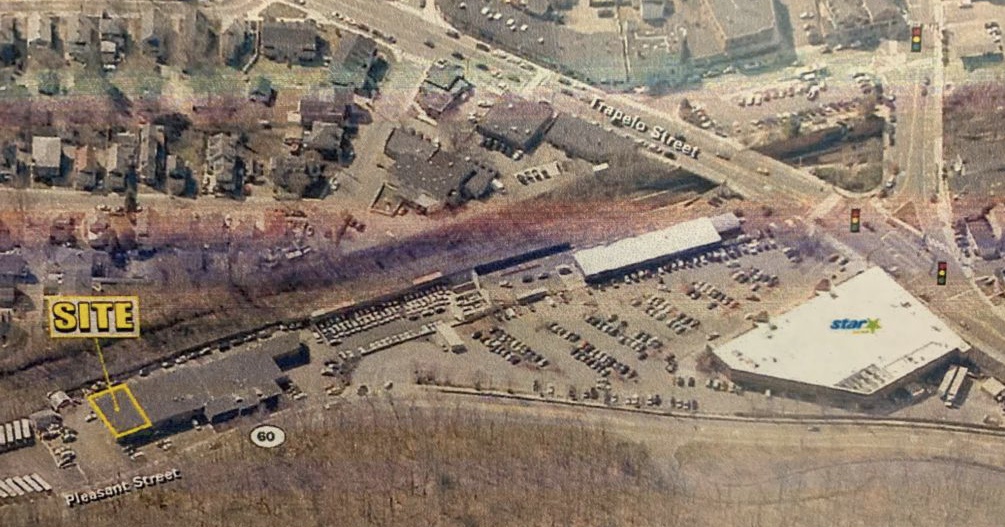
Winchester Couple Plans To Open Belmont’s First Pot Shop On Pleasant Street

Photo: A rendering of the proposed marijuana dispensary along Pleasant Street.

A Winchester couple has applied for a license and special permit to operate a recreational marijuana establishment on Pleasant Street.

Kelly and Stephen Tomasello have signed a five-year lease with Paul Tocci, Jr to turn a nondescript commercial storage site at 1010 Pleasant St. into Cal Verde Naturals, 3,600 square foot single story “retail wellness shop” with a large 2,100 square foot dispensary “providing consistent, high quality cannabis and cannabis products … at its proposed Adult Use Retail Marijuana Establishment,” according to the venture’s executive summery provided to the town.

The store’s proposed hours of operation would be from 8 a.m. to 8 p.m.

The business will also “invest significant dollars into converting both the exterior and interior of the premise into a first class retail establishment.” That renovation will include repaving the parking lot, which will have 36 spaces, and add state of the art security surveillance “to develop a safe and comfortable environment for employees and customer.”

In addition, the business has hired former Rochester, NH Police Chief Michael Allen as Chief of Security and who has created an extensive security plan with three levels of access control inside the operation.

“Calverde [the store’s name would use two words] will ensure sustainable business growth for years to come and prove to be an exemplary business partner with the town of Belmont,” the Tomasellos said in the summery.

Note: Cal Verde translates from Portuguese to “lime green.”

Patrice Garvin, Belmont’s Town Administrator, told the Select Board on Monday, Oct. 28 that “our next step is to meet with Community Development [Department] and start a timeline” for scheduling public hearings as well as begin negotiations with the business on a host agreement, which is essentially a fee to offset the financial impacts the businesses could “reasonably” impose on the host community.

Under the state’s Cannabis Control laws, the host agreement can not last for more than five years with fees that cannot exceed three percent of the establishment’s gross sales, on top of a three percent state tax. Municipalities can also impose “donations” above and beyond the three percent fees.

Belmont’s marijuana bylaw prohibits customers under 25 from purchasing pot and the restricts all deliveries from the site. The bylaw also limits retail pot businesses to the south Pleasant Street commercial area.

This is the Tomasello’s first venture into the burgeoning retail pot market, a business which will see US sales grow from $9.1 billion this year to $15.7 billion in 2022, according to BDS Analytics.

Kelly Tomasello, who is the company’s CEO and president, has worked in retail as a buyer and manager in California before moving back to her native New England to manage two high volume restaurants. She notes in her company bio that her interest in alternative medicine and wellness began with the birth of the Tomasello’s son who later was diagnosed with special needs. Her search for better treatment options and therapies made her more aware and accepting of non-traditional ways of self care and healthy living.

A Reading native and a 1994 Tufts grad, Stephen Tomasello, who is the company’s VP, has a quarter century in retail real estate brokerage with Atlantic Retail Properties.

Calverde is being represented by Joseph Noone of the Belmont law firm Avery, Dooley & Noone on Brighton Street.

Booo-reaucrats! Halloween At Town Hall; Monday, Oct. 28

Photo: Flying monkeys and a scarecrow in the Town Clerk’s Office.

It’s scarier than your next property tax bill and more deadly than a night debating bylaw amendments at Town Meeting.

What could be this frightening? It’s the second annual Halloween Trick or Treat at Town Hall on Monday, Oct. 28 from 4 p.m. to 6 p.m.

Town Hall and the Homer Building will host children and their parents for a bit of pre-Halloween joviality. Employees are once again encouraged to dress up in the spirit of the day.

As with last year, we will have tables and space available in Town Hall for Belmont Light, the Belmont Public Library, Belmont Police and Fire, and Council on Aging so those employees can participate in the fun as well.

Boost In Free Cash Likely To See Belmont Avoid A Spring Override Vote

Photo: The money is rolling into town’s free cash coffers (Wikimedia Commons, the free media repository)

Belmont Treasurer Floyd Carmen is fond of repeating a cautionary catchphrase when speaking about the town’s unrestricted fund account.

Free cash isn’t free,” says Carmen.

While it may not be free, by bringing in a robust $8.1 million in its unrestricted account, Carmen’s work will likely help the town balance the fiscal year’s budget without the need of a Prop. 2 1/2 override vote that appeared all but a certainty just six months ago.

The $8.1 million is just short of the $8.4 million in free cash the town held in fiscal ’18, an amount that Carmen warned the Board last year would not likely be matched. While the state advises municipalities to have a free cash amount equal to three to five percent of its annual budget, Belmont’s account is slightly more than 6.25 percent on a fiscal year budget of $129 million.

Free cash is made up of receipts – taxes and fees – in excess of revenue estimates along with unspent amounts in departmental budget line items known as “turn backs” for the previous fiscal year, plus any unspent free cash from the previous year. Before it can be used, free cash must be certified by the state.

The Select Board applauded Carmen’s accomplishment on the haul of free cash.

“I have to say I’m delighted and also astonished that free cash came in so high,” said Select Board Vice Chair Roy Epstein.

Carmen attributed the results to the town’s “fairly conservative” budgeting, department heads who work hard to return monies not spent and a tax and fee collection rate that caused one Board member to explain “wow.”

“Our tax collection rate is 99.6 percent,” said Carmen, who praised his staff for reducing uncollected receivables from $1.7 million on May 15 to just under $200,000 today.

While good government advocates suggest a portion of free cash be restricted to paying one-time expenditures and funding capital projects, Belmont will use a major chunk of the monies to fill in an expected gap in this year’s budget.

Carmen told the Select Board that he suggested to town officials transferring $2.5 million of the $8.1 million and place it into the town’s General Stabilization Fund, a special revenue account where monies are appropriated and reserved for balancing the town budget.

Added with the current balance of approximately $332,000, the Fund will end up with around $2.8 million in the Fund, about the same amount the account held last year at this time.

This amount will make up the bulk of the funding needed to fill a $2.3 million deficit in fiscal year 2021 that was predicted in August 2018 by consultants for UMass Boston’s Edward J. Collins Center.

“Just about three weeks ago, I finally could say we will have this covered,” said Carmen about the revenue hole.

While the Prop 2 1/2 override is all but certain off the April 2020 Town Election ballot, it is increasingly likely the override will be before residents in November 2020 to find a longer term solution for the town financial structural deficit.

Winter Town Meeting Likely Put On Ice As Skating Rink Pushed Up Against Party Primaries

Photo: Jack Weiss speaking to the Select Board on slowing down the process of approving a new skating rink.

The prospects of Town Meeting Members putting on their heavy coats and boots early in 2020 to attend a rare winter Special Town Meeting to approve two important requirements for a new town skating rink appears to have been put in the deep freeze.

The “special” scheduled for Monday, Feb. 24, 2020 to approve a public land sale for the rink as well as the approval of a new zoning bylaw to allow for a recreational building to be constructed will likely be shelved at the Select Board’s meeting this Monday, Oct. 7, due to the town needing to prepare for the 2020 Massachusetts Presidential Primary set for Tuesday, March 3.

According to town officials, the dates are too close to allow proper preparation for either events in such a short time frame.

It now looks likely the issue of the public/private agreement and the new bylaw will be taken up during the annual Town Meeting which will convene in late April 2020.

The date change to next spring for the new skating rink proposal [see what the new rink will be comprised of here] to come before Town Meet is in stark contrast to the lightning speed town and school officials had initially hoped the proposal to have taken place. The first version called for the bid to be accepted, a lease created, the Town Meeting vote and a contract awarded by December 2019.

Town and school officials pushed for the fast track approval process as the town’s existing ice surface, the nearly 50 year old ‘Skip’ Viglirolo Skating Rink adjacent Harris Field off Concord Avenue, is on the verge of failing. Without a replacement, the town would need to secure ice time for the high school hockey programs at a considerable hit to the school department budget.

But after listening to residents – such as Jack Weis and Bob McGaw – who warned at a public meeting last month that a project done in haste could result in costly mistakes, the Select Board in September extended the procurement of a public/private partnership by an additional 15 weeks. Rather than a mid-December date for the school committee signing a final lease with the winning bidder, the new date for the lease signing will be in late March 2020.

But this latest delay will now push the final lease signing into May 2020.

The additional two months will also allow residents who questioned the rink’s location, traffic generation and hours of operation to campaign for restrictions to be placed in the lease to mitigate those concerns.

It is reported that residents led by Anne Paulsen are seeking town wide support to locate five tennis courts on the new Middle and High School property in the general area of the proposed rink.